When I was Staff Director for the ODNI Directorate for Mission Integration, I ran the day-to-day operations of a 300-person organization responsible for some of the most sensitive mission integration work in the Intelligence Community. Budget, personnel, policy, stakeholder engagement across the IC, DoD, Congress, and OMB. All of it ran at the same time, under pressure, with real consequences if the machinery didn't work.
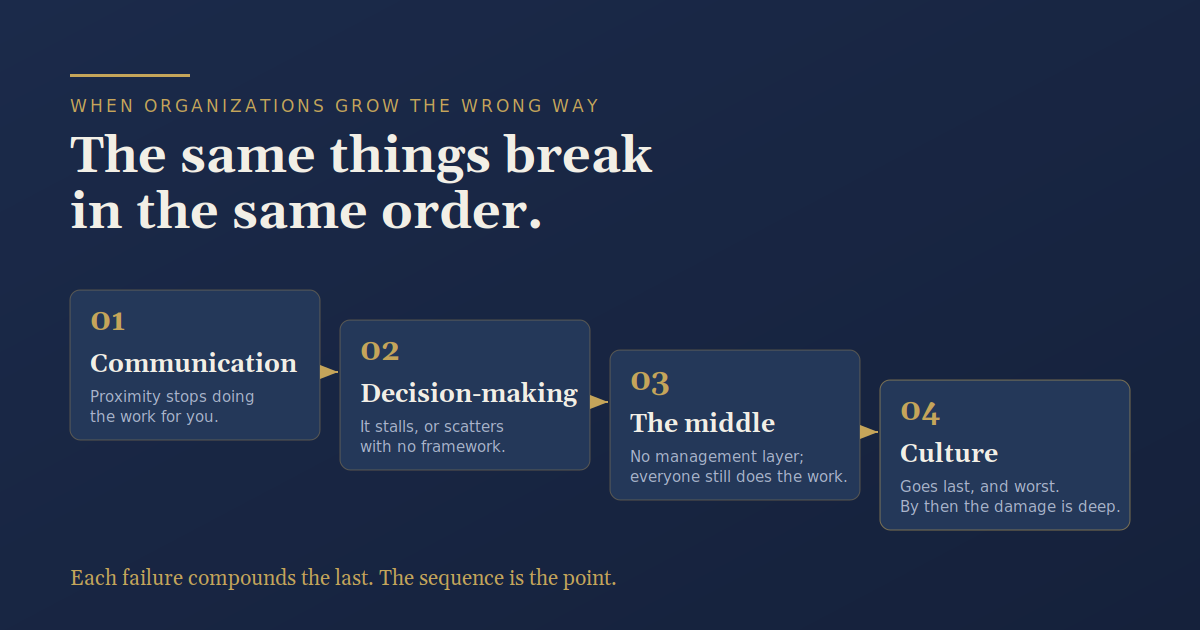
That role taught me something I've carried into every engagement since. When organizations grow in the wrong way, the same things break in the same order, every single time.
The private sector isn't different from government on this. The context shifts, but the urgency doesn't.
Communication breaks first
This is always the first thing to go, and most leaders don't notice it because it never shows up as a line item.
In a small organization, communication is ambient. Everybody knows what everybody else is doing because they share the same hallway and the same communication channels. Information moves without a process because proximity does the work for you.
Cross the 100-person threshold and proximity stops doing the work; cross 200 and it fails outright. People in one part of the organization stop knowing what another part is doing. Decisions get made without the right inputs, work gets duplicated, and guidance goes out that contradicts itself. Leadership doesn't see it, because the information that used to arrive on its own now has to be routed deliberately, and nobody built the routing becuase everyone was focused on external delivery.
At ODNI we ran a structured staff engagement model, a real cadence at every level. Weekly syncs between me in the MI front office and the component Chiefs of Staff; quarterly all-hands; weekly directorate-wide emails on missinon impacts; information moving up and across the organization on purpose. It was designed, not assumed.
Most growing companies don't do this. They rely on the communication model that worked when they were small and then wonder why nobody seems to know what's going on.
Decision-making breaks next
In a small company, decision-making is simple. The CEO decides, a few people weigh in, and the cycle is fast.
Growth doesn't just slow this down. It breaks it.
As the organization grows, more decisions need to get made, more people have equities in each one, and the CEO's calendar fills up to the point where they can't sit in every conversation. So one of two things happens. Either decisions stall while everyone waits on the CEO, or they get made down at lower levels with no framework for how to make them. One creates bottlenecks, the other creates inconsistency. Both are bad.
The fix is a decision-rights framework, often also called governance. Who can approve what, at what threshold, with what inputs. It sounds bureaucratic, but it's the difference between an organization that moves and one that's stuck. At ODNI I had clear authorities at every level. I didn't go to the Deputy Director or the Assistant Directors for every personnel decision; I had defined parameters. If it was within my authority I acted. If it wasn't, I knew exactly where it needed to go and how fast it needed to get there.
GovCon firms at the growth stage almost never have it. The CEO approves everything, which makes the CEO the bottleneck, which is why the CEO is exhausted. The organization reads the slowdown as the CEO not caring, but the truth is the CEO is drowning.
Then the middle gives way
By "the middle" I mean middle management; the layer between the CEO and the people doing the work.
In early-stage companies there is no middle. The CEO talks straight to the program managers, engineers, and analysts. It's flat and fast, and it works fine at that size.
Past about 75 people, you need a management layer. Not because you want one; because the organization can't function without it. Somebody has to translate strategy into execution across teams, manage people, and own the conflicts and resource fights and performance problems and cross-team dependencies that otherwise land on no one. That is what middle management is for.
The problem is that most GovCon companies grow by adding individual contributors; billable heads on contracts. They don't invest in management because management isn't billable. So you end up with a 300-person company, a five-person management layer, and every one of those five is also doing the work themselves.
This is where it turns painful. Projects slip, good people leave, morale sinks. The CEO can't figure out why, because the revenue still looks fine. And it is fine; the contracts are performing. It's the organization underneath the contracts that's fraying. The CEO hires a COO, and then places them on delivery too, reinforcing the back-office gap.
At ODNI, the Staff Director/Chief of Staff structure was the management backbone. Every component had one, and sometimes deputies. They ran the operations, the people, and the processes; they were the link between what leadership intended and what the organization actually did. Without that layer, a 300-person directorate would have been ungovernable. I know, because I watched organizations try to run without it, or worse, run it with the wrong person in the seat, someone who wanted the title and not the work.
Broken communication leads to broken decisions. Broken decisions hollow out the management layer. A hollow management layer is how the culture finally goes. Each failure compounds the last.
Culture breaks last, and worst
Culture is always the last thing to go. By the time you notice, the damage is deep.
In a small company, culture is the founder. The founder's values, the work ethic, the way they treat people; that is the culture, and it spreads because everyone deals with the founder directly.
Once the company grows past the point where the founder can touch every employee personally, culture has to move through systems instead. Through how you hire and promote, how you handle conflict, how you talk to each other. If you never built those systems, culture doesn't carry; it dilutes. Whatever local norms grow up on their own take its place, and they may have nothing to do with what the founder intended.
I saw it at ODNI, the Joint Staff, DIA, and NRO. The ones that kept a coherent culture at scale had built their values into the processes; not posters on the wall, the actual processes. It showed in how they ran a meeting, made a hard call, and treated people in a difficult conversation. Culture was operational, not aspirational.
The companies that tell me "our culture used to be great" are the ones that never operationalized it. They assumed it would sustain itself. It won't. Nothing sustains itself at scale.
The sequence is the point
I put these in order on purpose. The sequence is the whole point. Each break makes the next one more likely and harder to spot, until what started as a few missed messages ends up as a culture nobody recognizes.
The good news (and there is some) is that the order is predictable, which means you can stay ahead of it. Build the communication routing before it breaks. Set decision rights before the CEO turns into the bottleneck. Get a management layer in before your best people start updating their LinkedIns, and put your culture into the processes before it has the chance to thin out.
None of this requires a massive investment. It requires attention, somebody who has seen the pattern before and knows where to look, and a willingness to prioritize the machine alongside the mission.
Twenty years in the IC taught me that the organizations that win aren't the ones with the best strategy. They're the ones that built the infrastructure to execute the strategy. The organizations that lose usually had the same strategy on paper. They just couldn't execute it because nobody built the systems that make execution possible.
That lesson applies everywhere. It applies especially here.
Mike Dickerson is the Founder, CEO, & Managing Partner of The Tacitus Group, LLC. He spent more than 20 years in IC and DoD operational leadership and staff roles at ODNI (Mission Integration, NCTC, IC CFO), the Joint Staff, NRO, and DIA, including roughly 12 years managing IC task order portfolios at Booz Allen Hamilton.