I spent more than twenty years inside the Intelligence Community and the Department of Defense. I ran organizations with hundreds of cleared, motivated people, managed task order portfolios worth hundreds of millions, and stood up offices from scratch when the mission demanded it. The seats had different labels: Chief of Staff, Staff Director, program manager, contractor lead, across multiple IC agencies.
The titles changed. The work didn't. In every one of those jobs, I was doing the same thing; making the organization function behind the scenes. Not setting strategy. Not picking the hill to take. Building the machine behind whatever leadership decided and keeping it running.
That isn't a Chief Operations Officer. That's a Chief Administrative Officer. Most CEOs don't know there's a difference, and the cost of not knowing is high.
The COO problem
When a growing company starts feeling operational pain, the instinct is almost always the same: "We need a COO. The CEO is buried, things are breaking, somebody has to take ownership." So they post a COO job or start reaching into their networks for referrals.
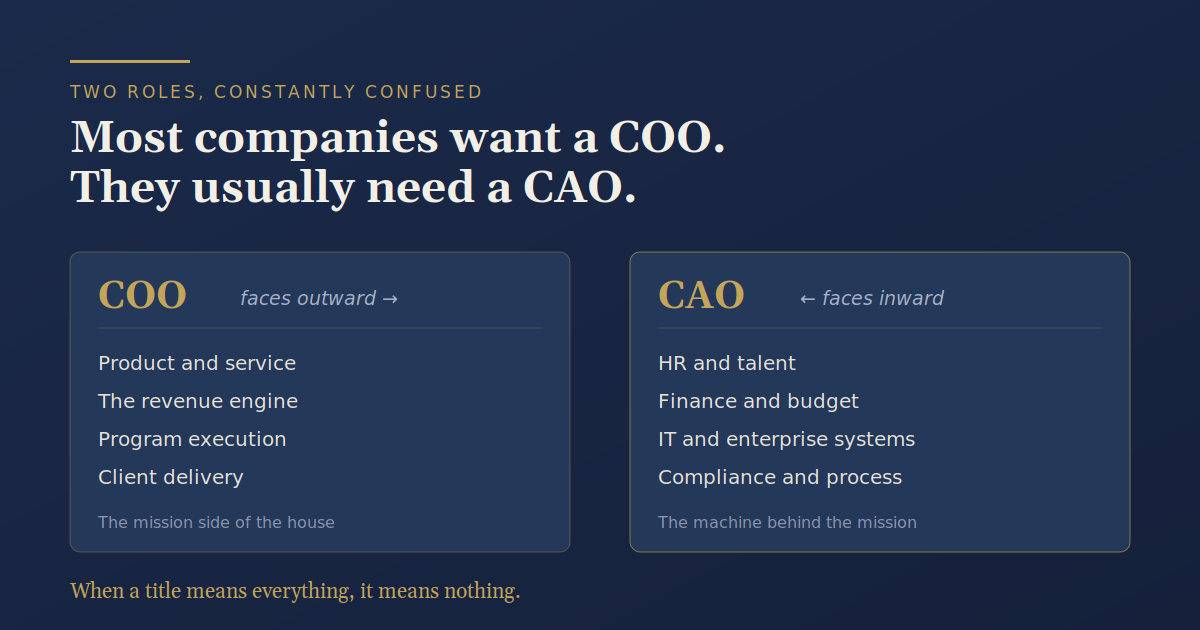
That's where it goes wrong. COO is the most overloaded title in business. Ask ten companies what their COO does and you'll get ten answers. One owns revenue, the next owns delivery, a third is the CEO's strategic thought partner, a fourth is running everything in sight. When a title means everything, it means nothing. And when you hire for a title that means nothing, you tend to end up with the wrong person solving the wrong problem.
What a CAO actually does
A Chief Administrative Officer is not a junior COO. It's a more precise role.
The CAO owns the operating infrastructure, the internal machinery that lets the company function: HR and talent, finance and budget execution, IT and enterprise systems, facilities, compliance, contracts, and the business processes that tie it all together. The CAO doesn't set strategic direction; the CAO builds the engine that executes whatever direction leadership picks.
We had a name for this in the IC, though it changed by agency: Executive Director, Staff Director, Chief of Staff. The badge changed; the job didn't. You were the person who made the trains run on time. You made sure the laws and policies were followed, the budget was managed, the personnel decisions got made, and the processes existed in the first place. You kept the mission-focused people focused on the mission by taking everything else off their plate.
That's the CAO function. It's structurally different from the COO function.
Drawing the line
The COO faces outward, owning the company's core operations: the product, the service, the revenue engine. In a GovCon firm that means program execution, contract performance, client delivery. Usually the COO is the CEO's number two on the mission side of the house.
The CAO faces inward, owning the organizational backbone that supports the mission: HR, finance, IT, legal, compliance. The CAO makes sure the company can actually deliver what the CEO and COO have promised. Without that infrastructure, the COO has nothing to operate with.
When companies conflate the two, one of two things happens. Either external operations suffer because the leader is buried in internal administration, or internal infrastructure rots because the leader is consumed by client delivery. I've watched both. Neither ends well.
Why this hits GovCon hardest
The distinction is sharpest in federal contracting, and that's also where I see the most confusion.
GovCon firms in the growth stage are almost always program-heavy and infrastructure-light. They grew by winning work, which was the right priority at the time. The back office never caught up. HR runs reactive, finance lives in somebody's spreadsheet, IT is a pile of tools nobody ever integrated, and compliance is mostly a prayer. The org chart is whatever happened to be standing when the music stopped.
These companies don't need a COO. They already have people who can execute programs; that's how they got here. What they need is somebody who can build the organizational infrastructure to support the growth they've already achieved and the growth they're planning for. That's the CAO seat, and in most of these firms it doesn't exist.
The IC had this figured out
Whatever else you want to say about the Intelligence Community, operationally unsophisticated isn't accurate. Every major IC element separates mission leadership from enterprise leadership. The Director sets direction. The Deputy Director or a senior mission lead runs operations. The Executive Director or Agency Chief of Staff (the CAO, in corporate terms) runs the organization; budget, people, facilities, IT, security, business processes, all of it.
That structure exists because the IC learned, the hard way and over decades, that you cannot ask the same leader to run the mission and build the machine that supports it. The skill sets don't overlap. Neither do the time horizons, and honestly, neither do the temperaments.
When I was the Staff Director for Mission Integration at ODNI, I wasn't deciding intelligence priorities. I was making sure the Directorate had the budget, the people, the processes, and the structure to execute whatever priorities leadership set. I represented the Directorate across the IC, DoD, and oversight bodies, and I managed the front office staff and the Chiefs of Staff across MI's components. That was a full-time job. It would have been impossible to do well if I'd also been responsible for mission execution.
When a title means everything, it means nothing.
What to look for
If you're a CEO or a PE partner trying to figure out whether you need a COO or a CAO, look at where the pain actually is.
If the pain is in program execution, client delivery, or revenue ops, you need a COO.
If the pain is in the organizational machinery (broken HR, a budget process held together with hope, IT systems that don't talk to each other, compliance running on duct tape, an org structure that no longer matches the operating model), you need a CAO. If you're honest with yourself, it's usually the second one.
The hire is not the charismatic operator who closes deals and runs programs. It's the quiet one who builds the systems, fixes the processes, manages the budgets, develops the people, and lifts the whole organization a level. The person whose work you don't notice until it stops getting done.
That person is a CAO. For most growth-stage firms in GovCon and national security, they're the hire that actually moves the company forward.
Mike Dickerson is CEO & Managing Partner of The Tacitus Group, LLC. He spent more than 20 years in IC and DoD operational leadership, including senior roles at ODNI, the Joint Staff, NRO, and DIA, and roughly 12 years managing IC task order portfolios at Booz Allen Hamilton.