Look at your CEO's calendar for the past two weeks. Count the meetings. Then ask the harder question: how many produced an actual decision? Not a discussion, not a "let's circle back," not an action item that became a follow-up that became another meeting. A real decision, with an owner and a deadline.
If the answer is less than half, your CEO doesn't have a time management problem. They have a Chief of Staff problem. More precisely, they don't have a Chief of Staff at all, and the absence is costing more than they realize.
What a Chief of Staff actually is
The title gets misused constantly, so it's worth being clear about what the role is and isn't.
A Chief of Staff is not an executive assistant with a better title, not a project manager, not a "junior partner" or "strategy associate" or deck editor or calendar manager. If somebody is doing those things, they're an EA. Give them the right title and the right comp, but don't call them a Chief of Staff. The work is fundamentally different.
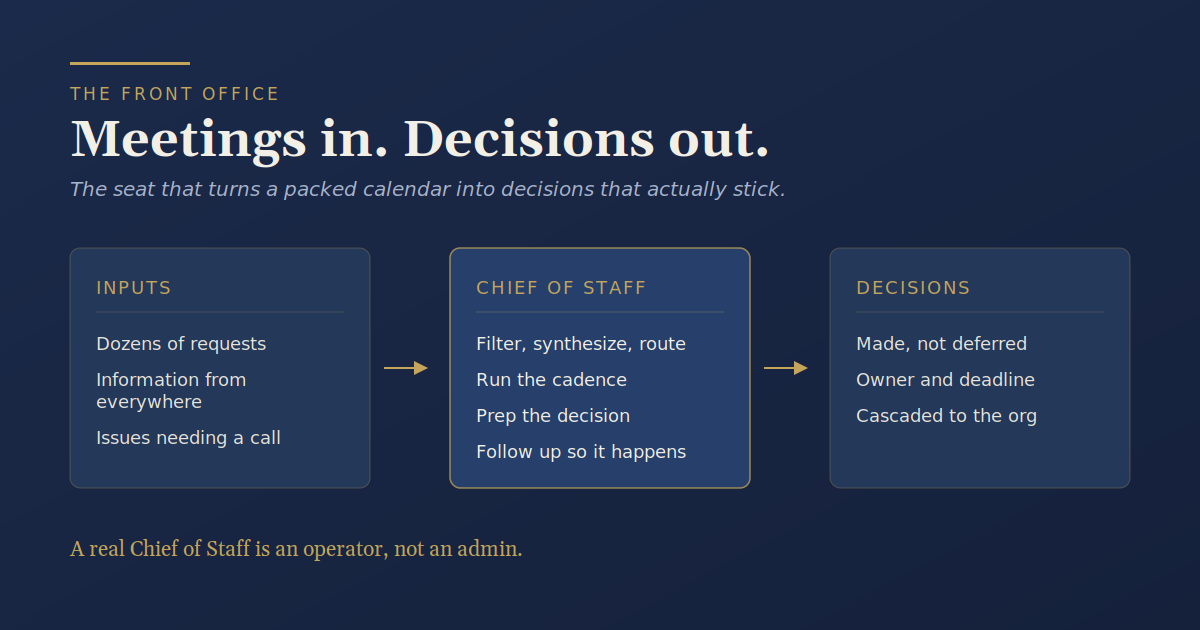
A Chief of Staff runs the front office. The job is to make sure the CEO's intent gets translated into organizational action: managing the flow of information to and from the CEO, running the internal cadence, preparing the CEO for decisions, getting the right people in the room when those decisions get made, and following up afterward so execution actually happens.
I've held this role, managed people in it, and built the structures that make it work across multiple IC agencies. The Chief of Staff function is the most leveraged seat in any organization, and it's the one growing companies almost universally either get wrong or skip outright.
The CEO without one
Here's what it looks like when the function is missing.
The CEO is in every meeting, not because every meeting needs the CEO, but because nobody else can speak for the CEO or act on their behalf. The calendar is packed. There is no time to think. Decisions either happen reactively in the room (without proper preparation) or they don't happen at all (because the CEO ran out of bandwidth before getting to them).
Action items leave meetings without owners. Or with owners but no deadlines, or with deadlines but no follow-up mechanism. So the same topics come back three weeks later: different meeting, same conversation, same lack of resolution.
The leadership team feels disconnected from the CEO's priorities, because those priorities aren't being communicated in any structured way. People fill the vacuum with assumptions, the assumptions diverge, and teams end up working at cross purposes. The CEO finds out three months later and wonders how it got there.
Information flows in but not back out. The CEO is taking dozens of inputs from across the organization every day, and without somebody filtering, synthesizing, and routing that information, the CEO either drowns in it or starts ignoring it. Neither outcome is good.
I watched these exact dynamics at IC agencies that hadn't invested in their front office function. I watched them disappear at agencies that had. The difference wasn't the quality of leadership; it was the presence or absence of the operational infrastructure around the leader.
What good looks like
When I was running the front office for ODNI Mission Integration, the Chief of Staff function had clear responsibilities.
Cadence management. We ran a structured rhythm: daily stand-ups, weekly leadership syncs, monthly component reviews, quarterly strategic assessments. Every meeting had an agenda and produced decisions or action items, every action item had an owner and a deadline, and a tracking mechanism kept things from falling through the cracks.
Information flow. I controlled what went to the Associate Director and how it was packaged. Not because I was a gatekeeper, but because the AD's time was the most valuable resource in the Directorate, and it was my job to make sure that resource got spent on things that mattered. Everything the AD saw was prepared, contextualized, and actionable.
Decision preparation. Before any significant decision reached leadership, I made sure the staff work was done: options developed, risks identified, stakeholders consulted, the decision memo clear. Leadership's job was to decide; the analysis was already in front of them.
Organizational translation. When the AD made a decision, I made sure the organization understood it, knew what it meant for them, and had what they needed to execute. That meant working through every component's Chief of Staff to cascade information and coordinate action.
That's the Chief of Staff function. It's not glamorous. It's not visible. It is, however, the reason a 300-person organization can operate with the coherence and speed of a much smaller one.
A real Chief of Staff is not admin. A real Chief of Staff is an operator.
Why GovCon companies miss this
GovCon firms at the growth stage miss this for the same reason they miss most internal infrastructure. It isn't billable.
A Chief of Staff doesn't win contracts, doesn't appear on a proposal, doesn't generate revenue on their own. So when the CEO is building the team, that hire keeps getting pushed to "next quarter." Meanwhile the CEO's effectiveness degrades, the organization slows down, and everyone blames market conditions or growing pains.
It isn't growing pains. It's a missing function.
The other reason companies miss this is they don't know what they're looking for. The corporate world has so thoroughly diluted the Chief of Staff title that most CEOs assume it means a senior EA or a strategy consultant who sits near the corner office. So they either hire the wrong person, or they don't hire at all because they can't justify "another admin."
This is the distinction that matters. A real Chief of Staff is an operator, not an admin. They have to understand how the organization works, how decisions get made, how to manage senior stakeholders, and how to make things happen through people they don't directly control. That's a specific skill set, one the military and the IC have spent decades deliberately developing, because those institutions figured out long ago that senior leaders can't be effective without it.
The test
If you're a CEO, here's the honest test. Answer truthfully.
Are you spending more than half your time in meetings? Do fewer than half of those meetings produce a clear decision? Do action items from your leadership meetings regularly go untracked? Does your leadership team sometimes work at cross purposes because they didn't actually know what you decided or what you're prioritizing? Do you feel like you're the only person who can keep all the pieces of the organization in your head?
If you answered yes to three or more, you need a Chief of Staff. Not an assistant, not a consultant. An operator who can build and run the front office function your organization has outgrown the lack of.
The role of a staff officer, and especially a Chief of Staff, is to enable business operations to occur; to make sure the rules are followed, the mission requirements are met, and the people and processes that support the mission are developed and functioning. I've described it the same way for twenty years. Making the trains run on time.
It isn't the most visible job in the organization. In most cases, it's the most important one.
Mike Dickerson is CEO & Managing Partner of The Tacitus Group, LLC. He spent more than 20 years in IC and DoD operational leadership, including senior roles at ODNI, the Joint Staff, NRO, and DIA, and roughly 12 years managing IC task order portfolios at Booz Allen Hamilton.