I've seen this story play out dozens of times. A technically brilliant leader builds an organization around a real capability. They deliver, hire more people, and continue to grow, either by winning work or by growing mission.
Then things start breaking. Not the technical work; the company is still good at that. Everything around it starts to go: the processes, the org design, the back office, the machinery that's supposed to hold the company together.
Nobody built the machine, and now it shows.
The pattern
Technical founders build technical companies. That isn't a criticism; it's how it works. They hire the engineers, the analysts, the subject matter experts, the people who can do the work. They invest in capabilities, tools, clearances, and contract vehicles. Every dollar flows toward winning and executing work, which is exactly the right priority for a young firm.
Somewhere between 150 and 500 employees, the internal infrastructure hits a wall. The symptoms are remarkably consistent. HR has become a compliance function instead of a talent strategy. Finance is producing reports nobody uses to make decisions. IT is a patchwork of tools that don't integrate, because each one was bought to solve a specific problem and nobody ever zoomed out. The org chart was drawn to match a contract structure (because that's how the company grew) and it doesn't match the operating model anymore. Middle management exists in name only. The CEO is in every meeting because nothing moves without them.
Why it happens
Internal infrastructure doesn't win contracts. It doesn't show up in a proposal. The customer isn't evaluating your HR processes or your financial reporting maturity. So in a resource-constrained environment (and every growing GovCon firm is resource-constrained, regardless of what the P&L says) the back office gets funded last.
That math works until it doesn't.
The moment you start losing good people because onboarding is broken, or you miss a compliance deadline because nobody owned the process, or the CEO is spending half their week adjudicating internal disputes because there's no management layer to absorb them, the math stops working. The company didn't fail at the mission. It failed at everything that supports the mission.
I saw this dynamic inside the IC repeatedly. The agencies that performed best weren't necessarily the ones with the best analysts or the most sophisticated platforms. They were the ones that had invested in the enterprise: budget execution, workforce planning, organizational governance. The boring stuff nobody writes profiles about, the infrastructure that lets talented people do talented work without fighting the system to get there.
The CEO trap
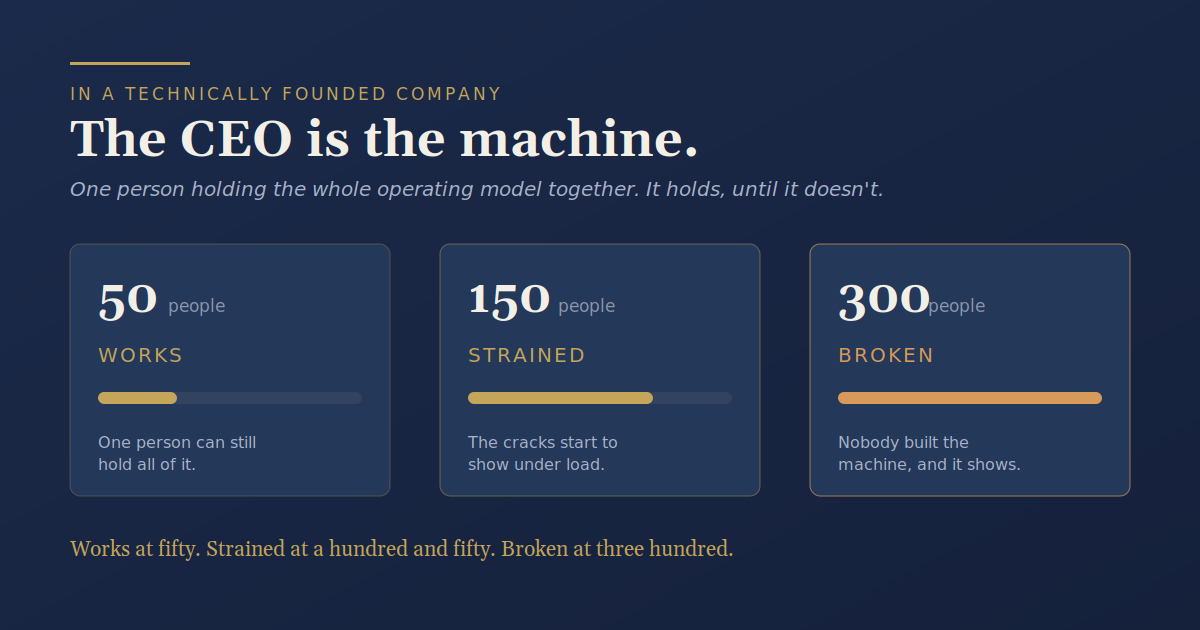
Here's the part that doesn't get said enough. In most technically founded companies, the CEO is the machine. They are the management layer, the HR department, the decision-making process, and the Chief of Staff, all rolled into one person.
That works at fifty people. By a hundred and fifty it's strained. By three hundred it's broken.
The CEO knows it's broken. They feel it. They're exhausted, making decisions they shouldn't be making, sitting in meetings they shouldn't be in, watching the organization outgrow the way it's being run. They don't know what to do about it because they've never had to build the machine before. They built the capability. That's a different skill.
The technical founder who can build a cyber platform, a SIGINT solution, or a logistics system is not necessarily the person who can design an organizational operating model, stand up a budget governance process, or build a real management cadre. Those are different competencies. There's no shame in that. The shame, if there's any, is in not recognizing it.
In most technically founded companies, the CEO is the machine. That works at fifty people. It's broken at three hundred.
What the machine looks like
When I talk about the machine, I mean concrete things.
Organizational design that matches how the company operates today, not how it happened to grow yesterday, with real reporting lines, defined roles, and a management layer that actually manages.
Financial infrastructure beyond basic accounting: budget governance, program-level cost tracking, forecasting that informs decisions instead of decorating board decks, reporting the leadership team uses every week instead of every quarter.
Talent operations beyond recruiting and compliance: workforce planning, career development, retention strategy, performance management that actually does what it should to keep your best people.
Enterprise systems that talk to each other, a tech stack that supports the business instead of forcing the business to work around it.
Business processes that are documented, repeatable, and owned by somebody specific. Not tribal knowledge. Not "ask Sarah, she knows how we do that."
None of that is glamorous. None of it wins awards. It is, however, the difference between a company that can keep growing and a company that's growing while quietly cracking under the weight.
Building it
The fix isn't complicated. It just requires being honest.
If you're a CEO who built the company on technical excellence, the hardest thing to admit is that your next strategic investment isn't another contract win or another technical hire. It's the organizational infrastructure that makes the wins you already have sustainable. It's the machine.
You don't necessarily need a full-time C-suite hire to build it; that's a big commitment for a company that isn't sure yet what the role should even look like. The work itself is finite and definable: assess where you are, design what you need, build it, and hand it off to your team to run.
That's the model I used for two decades in government. Stand it up, make it work, hand it off, move to the next problem.
The work isn't hard to identify. It's hard to prioritize, because it doesn't feel urgent until the day it suddenly does. By then, you're fixing problems that shouldn't exist instead of building the company you set out to build.
Mike Dickerson is CEO & Managing Partner of The Tacitus Group, LLC. He spent more than 20 years in IC and DoD operational leadership, including senior roles at ODNI, the Joint Staff, NRO, and DIA, and roughly 12 years managing IC task order portfolios at Booz Allen Hamilton.